Can Your Family Get ACA Subsidies in 2027 If Your Employer Offers Insurance?
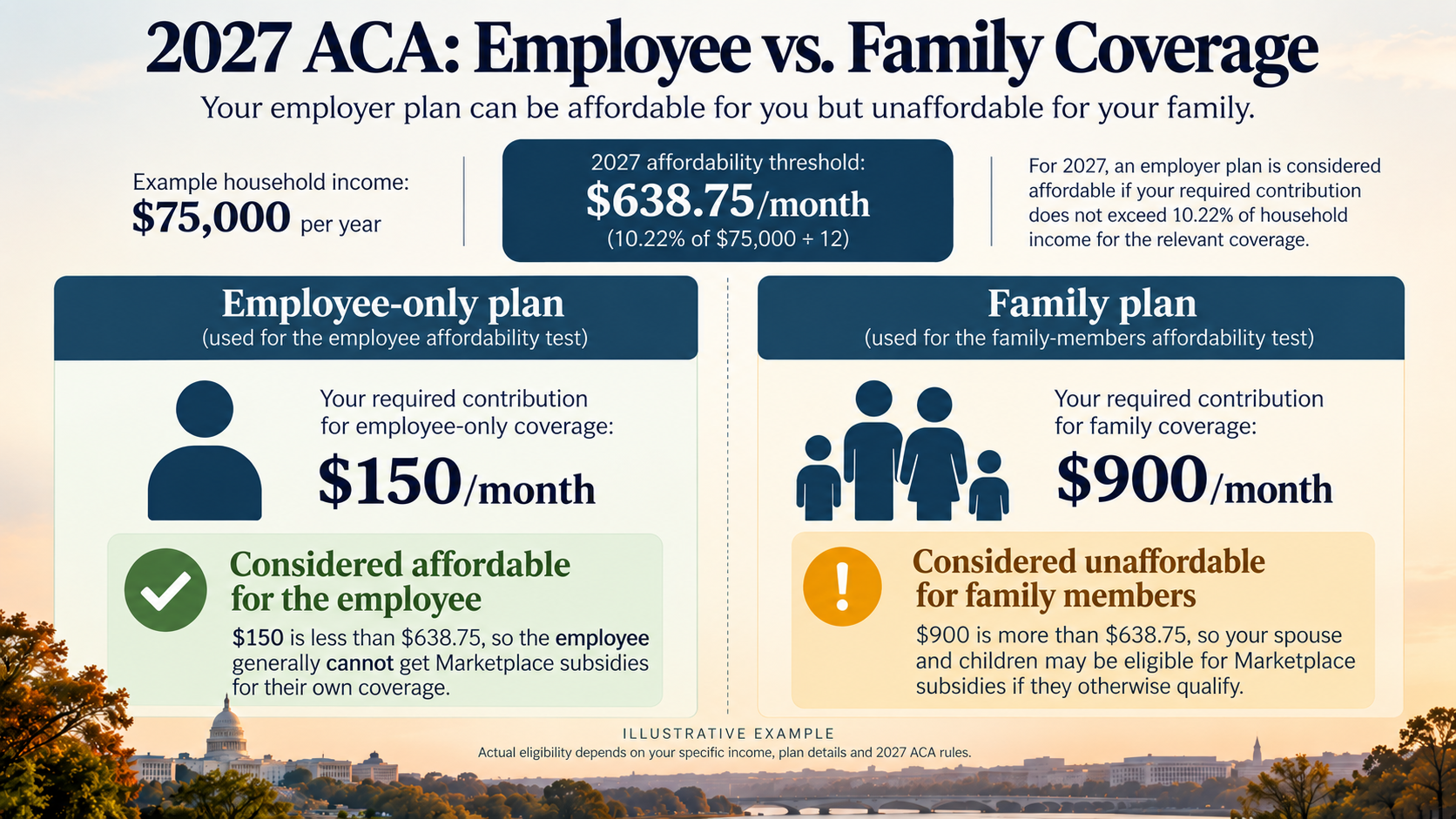
Your employer offers health insurance, but adding a spouse or children costs hundreds of dollars more each month. Can they buy subsidized coverage through the Affordable Care Act Marketplace instead? Possibly, even if your own job-based coverage is considered affordable. For 2027, the affordability threshold is 10.22% of household income, and the ACA applies different premium tests to the employee and to family members.
The employee’s test generally uses the cost of the lowest-priced self-only employer plan that meets the ACA’s minimum-value standard. The family’s test uses the employee’s cost for the lowest-priced qualifying employer plan covering the employee and all family members offered that coverage. An employee can fail to qualify for Marketplace premium assistance while a spouse and children may qualify, subject to income and other eligibility rules. HealthCare.gov explains the separate tests, and the IRS describes the family-coverage calculation.
A $75,000 Household: $150 for the Employee, $900 for the Family
Consider a married couple with two children and expected 2027 household income of $75,000. Assume one spouse’s employer offers minimum-value coverage costing the employee $150 per month alone, or $900 per month to cover all four people. Assume the spouse and children are eligible to enroll in that employer plan and have no other coverage offer that changes the calculation.
The 2027 affordability threshold works out to $638.75 per month: $75,000 multiplied by 10.22%, divided by 12. The employee-only contribution of $150 falls below that amount, but the $900 family contribution is above it.
| 2027 affordability test | Employee | Spouse and children |
|---|---|---|
| Employer premium used for the test | $150/month, self-only | $900/month, family |
| Affordability ceiling for this household | $638.75/month | $638.75/month |
| Result | Affordable | Unaffordable |
| Potential Marketplace premium tax credit? | Generally no | Possibly, if otherwise eligible |
The employee’s affordable offer generally prevents that employee from getting a Marketplace premium tax credit, even if the employee prefers to decline the employer’s plan. The spouse and children have a different result: because their available family coverage is unaffordable under this example, they may qualify for Marketplace savings. It is entirely possible to have one adult insured through work and the rest of the tax household enrolled in Marketplace coverage.
This example determines whether the employer offer blocks subsidies; it does not calculate the subsidy. The family’s actual premium tax credit also depends on the cost of eligible Marketplace coverage in their area, their household income, their eligibility for other coverage, and whether they satisfy the ACA’s other conditions. For 2027, the ordinary premium-tax-credit income ceiling is 400% of the federal poverty level; see our 2027 income-limit calculations before assuming an unaffordable work plan automatically creates a subsidy.
What If Family Coverage Costs $600 Instead?
Keep the same $75,000 income and $150 employee-only premium, but reduce the qualifying family premium to $600 per month. That is below the same $638.75 affordability threshold. Under these assumptions, the employer offer would generally be affordable for both the employee and family members, so none of them would qualify for Marketplace premium tax credits on the basis that the employer plan is too expensive.
The threshold varies with income. For a household earning $50,000, 10.22% works out to roughly $425.83 monthly; at $100,000, it is approximately $851.67. Those figures are an affordability test, not the amount the Marketplace promises you will pay for a Silver plan. The IRS’s 2027 Revenue Procedure 2026-26 establishes the 10.22% percentage.
Five Details to Check Before Applying
Get the correct premium figures from the employer. Ask for the employee’s contribution to the least expensive self-only plan that meets minimum value and the least expensive qualifying option covering the employee and all offered family members. Do not automatically use the cost of your current richer plan, or just the incremental amount charged to add a spouse. If the employer offers several plans, the relevant lowest-cost qualifying plan can be different from the one your household would actually choose.
Check whether the plan provides minimum value. An employer plan normally meets that standard when it is designed to pay at least 60% of covered medical costs and satisfies additional requirements for physician and inpatient hospital services. The employer can confirm whether its option meets the standard; the affordability test by itself does not establish it. The IRS provides the technical definition.
Check everyone’s other coverage offers separately. A spouse might have their own affordable, minimum-value employer plan, and children might qualify for Medicaid or CHIP. Those offers or government programs can affect Marketplace assistance even when the first employer’s family premium is unaffordable. Subsidy eligibility is determined for the people seeking Marketplace coverage, not uniformly for everyone living at one address.
Distinguish having an offer from actually enrolling. An affordable qualifying employer offer can block Marketplace premium tax credits even if you turn it down. Conversely, someone who actually enrolls in employer coverage generally cannot also collect a premium tax credit for Marketplace coverage for the same months. Before making a switch, confirm when the employer plan can be declined or changed and when Marketplace coverage can begin.
Use projected 2027 household income. The 10.22% test and Marketplace subsidy eligibility rely on household income under ACA rules, which can differ from one employee’s salary. Household adjusted income can include investment gains, taxable retirement distributions, and a spouse’s earnings. Our guide to what counts as 2027 ACA income explains how to assemble the estimate.
Compare the Combined Cost, Not Just the Family Premium
In the $75,000 example, using employee-only coverage costs $1,800 per year in payroll premiums, while the $900-per-month family plan costs $10,800. The apparent $9,000 difference makes a split arrangement worth pricing, but it is not a projected saving. You must add whatever the spouse and children would pay for their Marketplace plan after any premium credit, then compare deductibles, out-of-pocket limits, covered drugs and provider networks on both sides.
A split arrangement can involve two deductibles, different prescription formularies, and doctors who participate in one plan but not the other. If children qualify for CHIP, that could alter the best configuration again. The comparison should reflect the medical care your household actually expects to use rather than stopping at the payroll deduction.
Before the 2027 enrollment period, request the employer’s family premium schedule and minimum-value information, estimate household income, and complete a Marketplace application that discloses the employer coverage offered to each person. The Marketplace can evaluate each family member’s possible savings separately. Our 2027 Open Enrollment guide covers the dates and enrollment process; verify your own state Marketplace’s deadlines as well.